

It goes like this…
You call your agent.
You say your agent’s name at the front desk.
You’re forwarded to an assistant and you announce yourself.
The assistant replies, “I don’t have them right now. Can they return?”
No specific time to call you back. No “How about 2 o’clock?” or “You around in fifteen?” Just at some point, they’ll return.
If they need to get in touch with you first, rarely do they schedule the call as with any other professional relationship. It just comes out of the blue. If you miss it, you start over at the front desk.
It’s a destabilizing cycle.
Agents taking away your agency.
Can you tell I don’t trust the system? In a dozen years, I have gone through three managers, and my most recent discussion with my only ever agent has left me feeling that this won’t last much longer. I do trust my entertainment lawyer, as she has the good sense to say things like, “that’s something to talk about with your therapist.”
But I have also gone through about six or seven therapists and three psychiatrists. I think what happens is that I don’t trust that someone really cares about me when there’s money involved.
“I want to make this project“ becomes “we need to sell this project.“
“I want to cast this actor” becomes “we need an actor who adds value to get it made.”
“I want to feel better“ becomes “we need to spend time together finding tools that work for you.“
So it would make sense that if it’s “I want to stop being addicted to drugs,” that the solution would be going through the 12 steps with a sponsor, where there is no money exchange. And I have been more attracted to that program ever since it was described to me as being open to having a spiritual experience.
But as Low Maintenance explores, do I leave behind the identity of the Guy with the drugs to pick up the identity of the Guy without the drugs.
Do I have to be an addict for the rest of my life — can’t I just be a human being?
As my teacher Ram Dass once cautioned about social roles: “I’ll make believe you are who you think you are if you make believe I am who I think I am and we’ll get along fine.”
I’ll be the writer/actor/director and you’ll be the manager/agent as long as you get 10%.
I’ll be the patient and you’ll be the therapist, as long as it’s in-network and 45 minutes.
I’ll be the addict and you’ll be the sponsor, as long as you work the steps and keep your share around 3 minutes.
I’ll be the performer if you’ll be the audience, as long as you buy a ticket.
The work I care most about is that which I’ve built from the ground up, outside of the system. It could just be my control issues with authority — being told who I am and what I can do — but we do get caught in these roles, and my goal is to shift from role to soul. Without conditions.
Even though you try to put people under control, it is impossible. You cannot do it. The best way to control people is to encourage them to be mischievous. Then they will be in control in a wider sense. To give your sheep or cow a large spacious meadow is the way to control him. So it is with people: first let them do what they want, and watch them. This is the best policy. To ignore them is not good. That is the worst policy. The second worst is trying to control them. The best one is to watch them, just to watch them, without trying to control them.
- Suzuki Roshi
I like to dance at certain parties for access to the soul. At an 8pm - 8am dance party called LSD (Last Saturday Dance party) in Brooklyn, where the floor is waxed for dancers to glide past one another, transcend with each other, with or without drugs, without lechery or bravado or being The Guy. When the sun comes and the enthusiasm holds, it’s religious. At the end of the last one, Ted Lucas’ It’s So Nice To Get Stoned brought us all back to earth. The all-nighters leaned on each other in a close circle, swaying together as one, like a muted version of the end of Fellini’s 8½. The music stopped and we held the circle in silence.
So when I tried to replicate that in Los Angeles at KNAZAAL, dissociating with people who don’t move their feet, being asked “what are you working on now?,” even entertaining recording a podcast on the topic of trust with the person who overdosed “the Guy from High Maintenance” and “Reggie Watts” — I couldn’t help but feel this all had something to do with, as my subscriber Patrick noted, “crazy Hollywood shit.”
The trust is broken. Hollywood is broken. My ambition is broken.
So fuck ‘em. (and I’m also waiting for ‘em to return)
A handful of people reached out after my SURcling the Drain post, some of whom I haven’t seen in a long time, some strangers on Substack, very worried about me. — worried, they said, in the way people are worried from a safe distance. An overture without a plan. I appreciated it and I didn't know what to do with it.
My daily friends were also worried, but they were less dramatic. They’ve seen my ups and downs more regularly, and without minimizing my oopsie, lovingly asked: What was that like?
Addicts not far from my house living in tents on the street have few worrying for them. So thank you, worriers. It’s love and I am grateful for it, in whatever form it comes.
That being said, people worrying about you is, well, worrying. My nervous system needed to rest, away from the stress of folks concerned for me.
So I hung out at SUR’s house almost every day this week. It seemed like a place away from the temptation of drugs where I could rest and recover after my harrowing weekend. But perhaps SUR is my next drug: he soothes me.
He still calls me St. Clair, the patron saint of screens. Her story is that while weak from being a renunciate, she stayed in bed while her sisterhood attended mass. Her miracle is that she was able to see the mass projected onto the wall across from her bed. This was in the 13th century.
I told him I’m not interested in making TV anymore. It’s a dying art form. He replied:
“There really is something to just letting them be.”
In the above vintage SURmon, he discusses the nature of the camera:
“The camera only points to one person. And when the camera points to one person, what happens to the rest. The camera is a weapon. It shoots… Do you want to be the shooter?”
But instead of banishing the weapon, they pass it around. Everyone gets to shoot. Everyone gets to be shot. No designated operator, no approved angle, no one whose job it is to decide what matters. The camera moves through the community indiscriminately. They’ve built up this enormous archive of footage, years of it, conversations and rituals and the daily nothing of living together — and they have done almost nothing with it. It just exists somewhere on a hard drive, uncut, unpitched, unmonetized.
My first instinct was pity. What a waste. And then I caught myself having that instinct and felt a little sick. And then I wondered if catching yourself was just another kind of performance. And then I put that thought down because you can do this forever.
The mask work is called “Who Am I?” SUR takes you to a table of masks. You pick a mask, sit across from him, and you and him go back and forth — you ask who am I?, he asks who am I? — like the Meisner technique to break self-consciousness — that quality of repetition that stops being a question and starts being something else. You switch masks, but he stays with his original face. You keep switching, he keeps watching, and at some point he takes the masks away and you’re just sitting there with your original face, asking the same question. Which turns out to be the harder mask to work with.
When it was over, he put his hand on my head and said: “For the rest of your life.“
Last weekend, while overdosing on OPC-E, somewhere in the middle of whatever that was, I asked Who am I?, and someone said: you’re Ben Sinclair. And I repeated: for the rest of my life?
Fuckin’ A, he did it again… How did he know?
“I read your substack, man.”
Good one.
He’s a rascal, but he spends most of time just letting them be: morning movement, SURmon under the grove, salad lunch, art projects, chores, rest, sunset on the hill, family dinner, singing SUR to sleep — but nobody’s being developed. There’s no Cookie. I keep waiting for the Cookie and it keeps not coming.
Everyone’s pretty much just hanging out: filming, cooking, gardening, jamming, crafting & salad.
I’m calling it SURbriety. Treating one’s life not as a problem to be solved, but a laid-back art project to be explored. No thirty-day chips or forever labels. No sponsor keeping your share to three minutes. No steps taking your inventory. You just show up, pass the camera, put on the mask, ask the question, don’t insist on an answer.
But my personal history suggests this place is temporary for me. It’s that familiar new relationship energy: how much I want it, how I know it will work, how everything’s different now!
Suresh, the old guard member and SUR’s archivist, pulled me aside and asked how I made my web series. It sort of hurt to be pulled back into The Guy again, but I recounted my journey. I could see his wheels turning. He’s wanted to get the word out there for a while but doesn’t know the entertainment industry. I suggested the lowest barrier would be a podcast.
Enter journalist Jennings Brown. He’s covered spiritual communities in The Gateway podcast about Teal Swan and Revelations about the Fellowship of Friends. A friend connected us; apparently despite the spiritual abuse he documents, he’s been interested in covering “the good cult.” Suresh bristled at the word; but he conceded that Wild Wild Country brought attention to OSHO without imploding it. Maybe upending the traditional cult narrative could make SUR stand out from trauma porn like The Vow.
I called him.
After the call I found myself feeling something unexpected about Jennings — not suspicion, but recognition. He’d gotten close enough to a real thing to be changed by it, and now he couldn’t unknow what he knew, and he couldn’t throw the camera away either. He was stuck in the same place I was stuck.
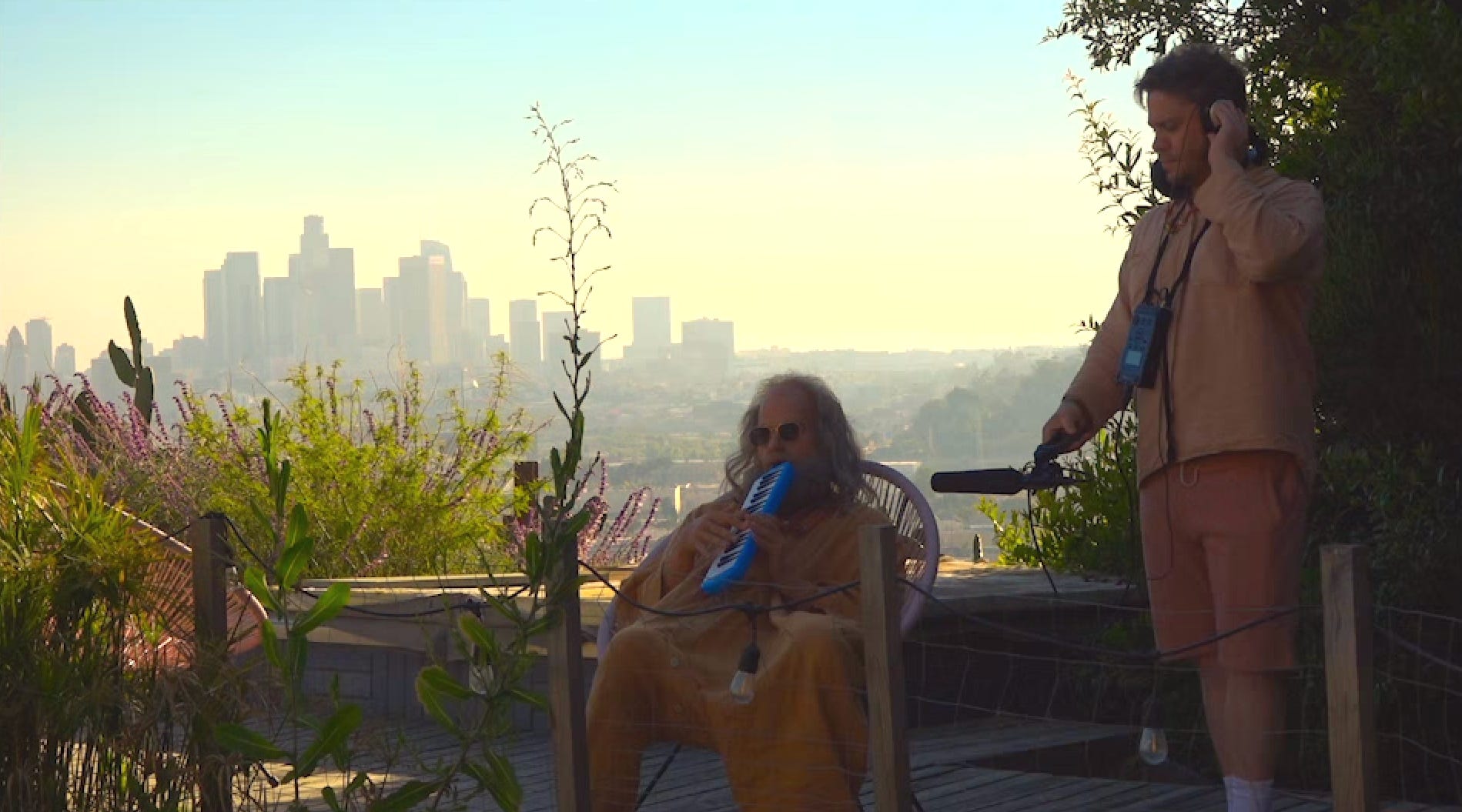
But when Jennings arrived at the compound with his phallic-shaped mic, I had my doubts. He described himself as a journalist who “embeds in cult compounds.” You could almost hear the record scratch. Cult implies spiritual abuse, and Jennings seemed primed to sniff out a sellable story of money, sex and power — what’s going to happen when SUR passes? Aw shit. Now I’m the guy exposing this community to someone just looking for a hook. Suresh asked me to keep an eye on him. I picked up a camera and pointed it at him, putting him on notice.
But then I saw what I was doing: objectifying, flexing, dick-measuring, giving myself the ick.
The camera is a weapon.
I got that ache of discovering this place too late, right when it’s about to be over. SUR’s an old man. At some point Jennings Brown is going to publish something, or Suresh is going to figure out the pitch, or someone’s going to show up with a development deal and a phallic-shaped mic and the sheep will become the cast and the meadow becomes a location. And it’ll ruin everything.
I found SUR and asked forgiveness for inviting Jennings. It was sort of pathetic. I talked a mile a minute, and he just listened, smiling. When I finished, SUR suggested I help him film a “one-on-one” with the resident A/V expert, Surcher.
Surcher is a very sweet guy. After a sudden separation in December, he came from the east coast to sunny L.A. looking to shake things up. Suresh found him on Craigslist to help with the technical side of filming and editing. It didn’t take long for him to fall hard for SUR. Despite being here only six months, he has the air of lifelong commitment. Usually he films the one-on-ones alongside SUR; but today SUR asked me to hold the other camera. He hinted that it was a spiritual practice — to be behind the camera instead of in front of it.
SUR’s elegance lies in that the whole week he never addressed my fear directly. He just pointed the camera at Surcher’s instead. Same fear. Better angle.
There really is something to just letting them be.
As the sun went down, we moved to the hill on the edge of the property to catch the golden light. Surcher and I teamed up — me on the wide shot, him on the handheld. Once the wide shot was set up on a tripod, I ran over and took the camera from Surcher. SUR asked me to direct them, so I asked them to walk together in a line. Surprise, an artist who had just joined for golden hour, suggested we form a sitting circle instead, and I passed the camera to Suri Ma so I could join.
You can see the Hollywood sign from the hilltop.
But we all turned away from it, into the circle, toward one another.
It is so nice to not get stoned. And never ever come down.
In anticipation of outreach from those worrying I’m joining a cult:
Can I return?


