
KEEP GOING LOSER
Reclaiming the L word

I have not stopped smoking weed. The day I wrote a post about my dead friend who said that I shouldn’t smoke weed, I went to the weed store and smoked weed alone in my apartment. Over the course of the week, I would have frank conversations with friends about how they shouldn’t feel bad about enabling me while we smoked pot together.
And at the time of writing this, I am coming down from other drugs.
I realize the appeal of this substack is not dissimilar to Snoop’s social media post where he declared “I’m giving up smoke.” It gave me pause about my own habits, until it was revealed to be a marketing stunt for a smokeless fire pit. Even after I had been duped, I found myself wondering what Snoops experience of quitting weed might be like.
While probably not a marketing stunt, there’s an element to this Low Maintenance experiment’s focus on getting sober that may be running on the vicarious hope and/or encouragement from readers with their own addictions — a heartfelt identification with grasping for our best lives that are just out of our reach. And my posts thus far tend towards raw, open and confessional — circling around this thought I have had about myself for a long time, which I numb out with weed:
I’m a loser.
Yes I am a loser. And so are you.
The word loser is defined by loss. And so is life.
No matter how much we resist, the fact is that everyone is destined to lose it all. And coming to terms with being a loser is what makes life so precious.
Entire civilizations struggle with being losers — stories of the afterlife to soften the blow. The Egyptians built pyramids to cope. But no matter how enduring the structure, those will decay too. Beck seemed to understand this at a young age.

Since I’ve engaged with Substack, I’ve felt like a loser slipping back into addictive, mindless “like”-checking that I thought I put behind me when I went off social media in 2019. But yesterday a person reached out to me to talk to them about their own drug-dealing centered show pitch based on their own true stories. I agreed to talk with them and gave my two cents about their project. As a thank you they gave me $1000 (100,000 cents) worth of psychedelics, packaged as if they were being sold in Erewhon. No weed though. Maybe they read my essays about my weed problem.
Some friends came over in the evening and we sampled the gamut. I stuck with the ketamine and the lowest dose of MDMA gummies. We made music at my apartment on my Teenage Engineering OP-XY before we went out dancing in Williamsburg. While dancing on drugs with friends I’ve known for over 20 years, I was having a genuinely good time. I was aware of my transgressions, but I didn’t really care for a few glorious hours. I just accepted that I was a loser. And it felt really great.
A few days before this, a friend and I accidentally coined the term “keep going loser” while stoned. We nearly peed ourselves laughing. And it stuck with me in the days since. While I danced, I kept saying to myself “keep going loser” over and over again. A paradox. A zen koan. A brain breaker. Equally encouraging and discouraging — a helping hand and a gut punch. But also, a refreshing frankness. It acknowledges that so many of us struggle with feeling like losers. It can be said in a winking way to suggest, “I see you struggling with the story you tell yourself about yourself. I get it. Keep going.” It acknowledges that we aren’t alone in our discomfort that, in spite of all of our wins, nature dictates our destiny to lose it all.
So I attempted an experiment with friends and strangers in the venue. I prefaced it by saying I was attempting a rhetorical experiment and it wasn’t what I actually thought about them. Once they consented to the experiment, I simply told them, “Keep Going Loser.” And almost every time, the person flinched.
Being called a loser has the same visceral power as words like FUCK. HITLER. JESUS. SEX. RAPE. TRUMP. They are words that when introduced to the conversation drastically change the energy. It’s like sitting a magnet next to a pile of metal filings.
But what I found fascinating is how no one reacted to “keep going.” To me, these sentiments carry equal positive and negative charge. But no one heard the keep going part. They focused on the loser part. They felt hurt even though they knew it was an experiment. We would discuss how they felt, and what I hoped to explore in this paradox. After all, aren’t losers exactly those who need to be told to keep going?
While enjoying my k hole on the couch, I kept thinking about whether I could turn “keep going loser” into a movement — to integrate our mandatory loss so that we may transcend its threat. It could be exposure therapy for shame, a joke that briefly frees us from self-surveillance, a refusal of delusional success narratives that inflate our self-importance over others. Being a loser as an act of surrender.
This inner collapse mirrors something bigger; because beyond losing as individuals, we are also losing collectively as humans.
Open a newspaper. We are losing. We’re fucking losers.
We are the drivers of the sixth mass extinction on Earth. We will lose it all someday, just like the dinosaurs. They were fucking losers too.
I kept workshopping my new slogan, feeling like I coined the next “FUCK” and imagined grandiose events with roaring stadiums where one by one people got up on stage and deleted their social media profiles. Finally, people were free to be losers. I felt powerful — even though I was sinking into this couch, I might actually be the most important thinker of this generation. Maybe I could save the world.
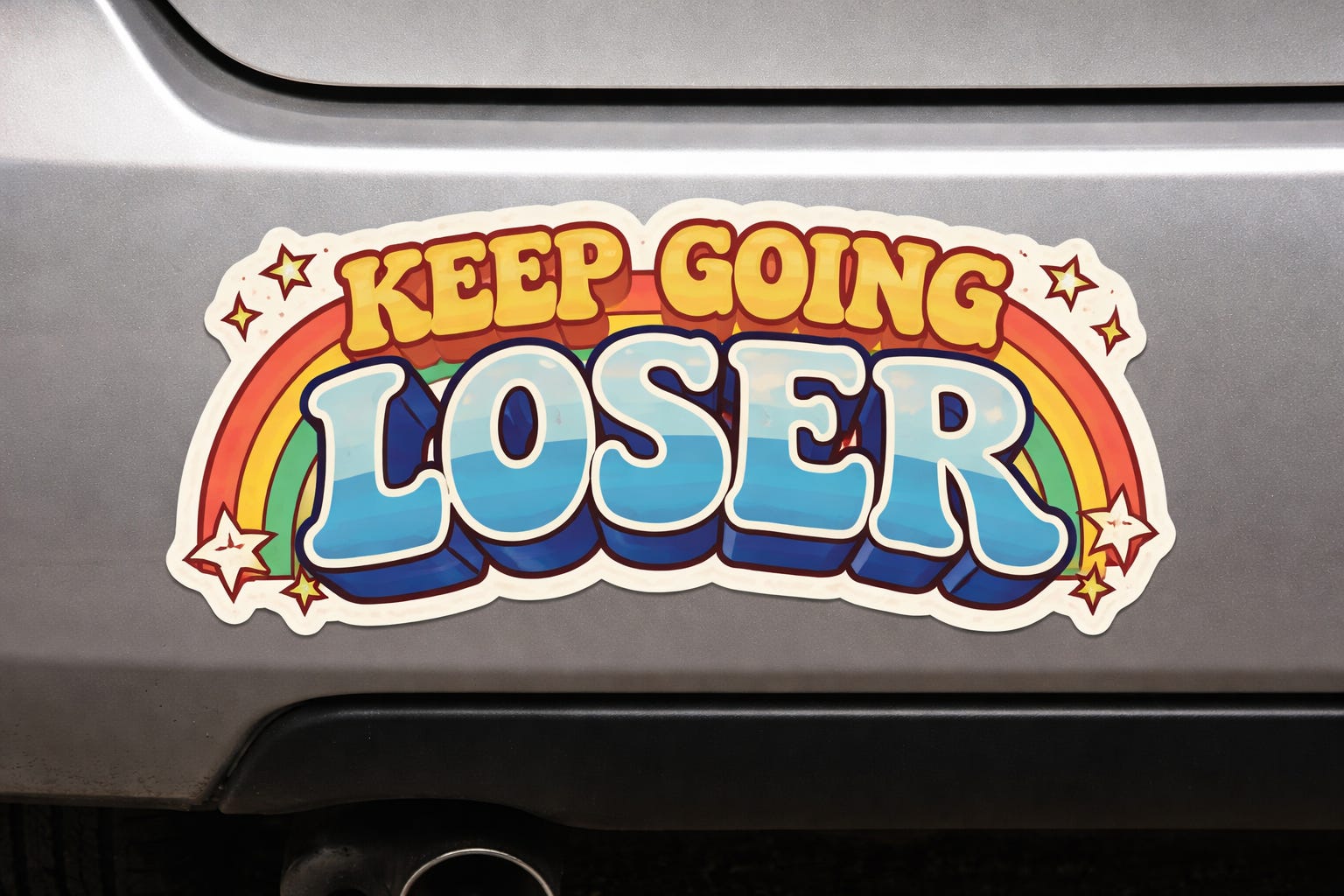
As the dance party wound down, the last person who agreed to the experiment — a woman who told me she could play Chopin for me were she not so drunk — also focused on the loser part of the statement. She stepped back and slurred, “I don’t see myself as a loser.” Her friend told me that she needed to hear the “keep going” part right now. And then I realized that I was not a genius, but actually an asshole on ketamine. I gave her a hug and told her I love Etude in E.
My friends and I went back to my apartment where we again jammed on my OP-XY — I played a very soft and uplifting melody while they improvised lyrics wherein they, both men of color, jocularly pressured me to say another viscerally charged word that begins with n. And while no one said the full word, I appreciated the comedic juxtaposition of the uplifting music with the tension of whether the forbidden word would be uttered — it was funny for its transgressive tension, not its actual sentiment.
And somehow after that, we ended up listening to Peter Gabriel’s Games Without Frontiers, Mercy Street, and coincidentally Don’t Give Up (loser). We mused at the vulnerability of Gabriel’s voice, the sophistication of the key changes, and wondered what melancholy he was trying to express through his music. We finished our night with Kate Bush’s “This Woman’s Work,” telling the story of a man helplessly waiting for his child to be born; and we all became emotional considering how well Kate Bush was able to musically and lyrically depict the spiraling quality of male anxiety that comes from that helpless feeling. Especially at the end of the song when the music swirls into a crescendo of regret:
I should be crying, but I just can’t let it show
I should be hoping, but I can’t stop thinking
Of all the things I should’ve said
That I never said
All the things we should’ve done
That we never did
All the things I should’ve given
But I didn’t
Oh, darling, make it go
Make it go away
I will surely experience a crescendo of regrets tomorrow. I will tell my partner that I did all of these drugs despite knowing I have a problem. I will try to get rid of this mountain of drugs gifted to me because I played a drug dealer on TV.
Someone will need to tell this loser to keep going.
keep going loser. the world is on fire and you are loved.
As someone who has spent years in the washing machine cycle of quitting weed, feeling good and clear and (let’s be honest) kind of smug about quitting weed… and then returning to a daily, habitual weed habit 1-4 weeks later—I really appreciate this post. I relate to the seesaw feeling of being buoyed by the camaraderie, laughter and creativity of being high, especially with my oldest friends, especially when it’s been a while, and also how absolute dog shit it makes me feel about myself. At the risk of being corny, I’m grateful for this newsletter. Please keep going, loser.